This is part three of five in a series of posts about my Tesla Energy system and
my understanding of how the system works.
In this post, I try to answer some questions you might have about what a system is capable of and how it can be configured as you evaluate whether solar or solar and a battery are right for you.
I suggest you read the first two parts, first:
- Home Electricity Fundamentals, since it covers some fundamentals about how electrical energy flows, which contributes to understanding the answers to the question here.
- Understanding my Tesla Energy System, since it covers the basics of the roles of each component in a Tesla Energy System.
Terminology
Here’s a quick reference of concepts/terms covered in earlier posts that are important to answering some questions:
| Term |
Quick Definition |
My Setup |
| The load that remains connected to solar and battery when the system is disconnected from the grid. |
Everything but my garage (where the car charges). |
| The load that is not connected to the “inside” system when it disconnects from the grid. |
|
| All non-backup loads should be attached to the Backup Gateway, but sometimes some circuits may remain attached to the Main Service Panel, or “MSP.” |
I have one outdoor outlet next to the MSP which is rarely used, so we left it on the MSP. |
|
|
Frequently Asked Questions about Tesla Energy systems
Q: Does the battery provide power to the non-backup load when connected to the grid?
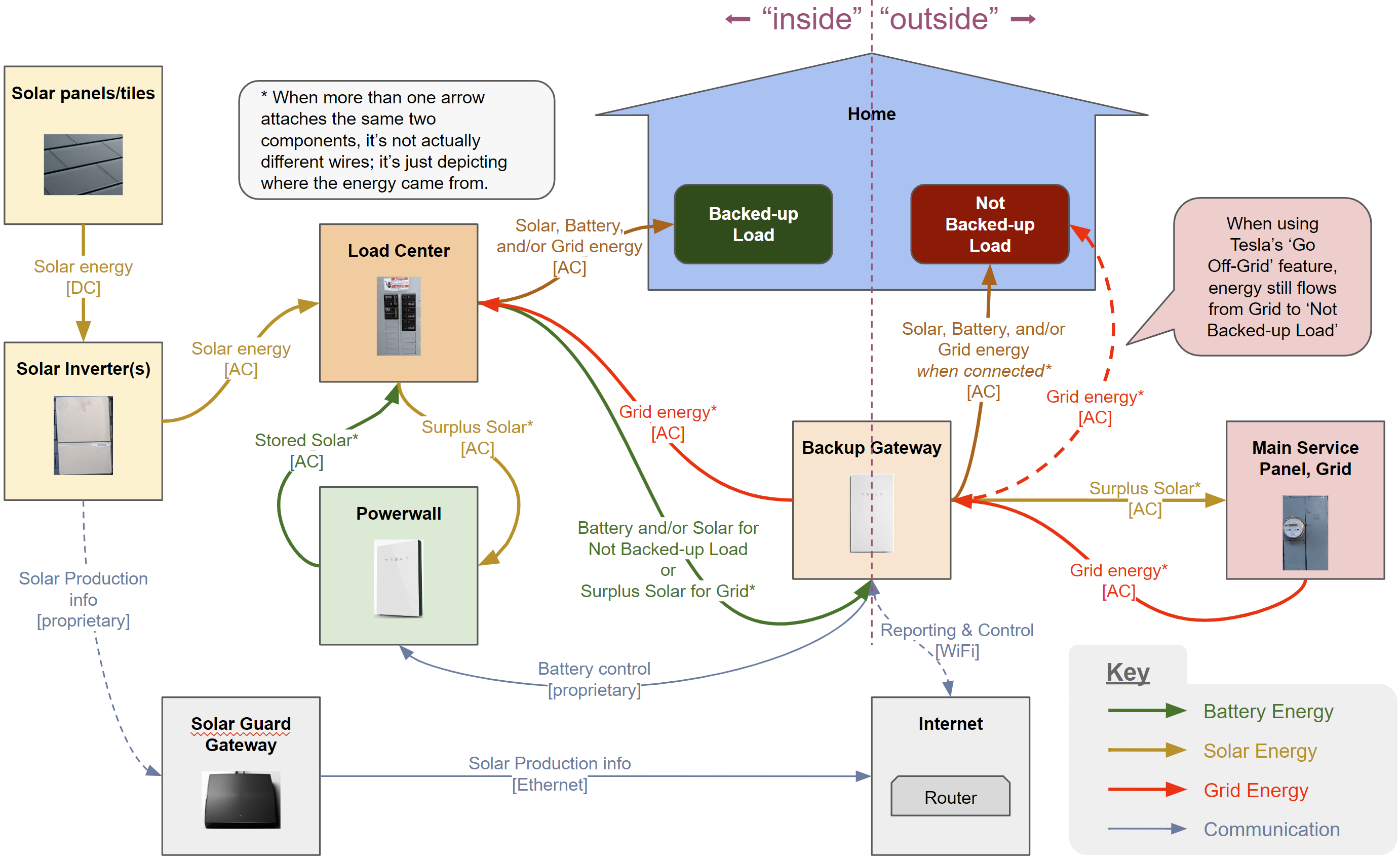
Yes, if it’s attached to the Non-Backup Load of the Backup Gateway. The Backup Gateway watches how much energy is being consumed by the Non-backup Load and tells the Battery to push enough to power it (as well as the Backup Load).
However, if there’s a circuit attached to the MSP (rather than the Backup Gateway), what I refer to as an “MSP-attached, non-backup load,” then the battery does not provide power it. The Backup Gateway Backup Gateway is not aware of its draw and thus is not able to tell the Battery to push enough power for it, too. This can mean:
- If there is excess solar (more than the Load Center loads — both the Backup Load and Non-backup Load — and the battery is not taking excess), then the solar would power such loads. It would not be reported in the Tesla app.
- If the loads are higher than solar production and the battery is supplying the remaining load, the battery would do so for the Non-backup Load attached to the Backup Gateway, but the MSP-attached non-backup load would be supplied by the grid!
Q: If the power goes out, can PV provide power to the non-backup load?
No. Because the gateway disconnects the “inside” from the “outside,” no power from the inside (whether PV or battery) can reach the non-backup load on the outside.
Q: What happens if I disconnect from the grid while the grid is still on?
If you disconnect from the grid while the grid is still on, the Backup Load can be powered by solar and/or battery (unless the load is too high, in which case the system shuts down).
The MSP-attached Non-backup Load will use grid energy.
Q: Do I need to upgrade my Main Service Panel?
Not necessarily, but that’s highly dependent on your home’s needs, your utilities policies, and more.
I didn’t need to because I had no new need to pull more from the grid than I was pulling before. That is, Solar + Battery didn’t change my needs.
If you believe your electricity needs will grow (e.g., to charge two EVs, or replacing gas appliances with electric), then while installing Solar/Battery would be a good time to also upgrade the MSP, especially if there are incentives that help cover the those (e.g., High-Efficiency Electric Home Rebate Act)
Q: Can I charge my battery from the grid?
In general, I cannot due to utility policy. I don’t know enough about policies elsewhere to give any more useful information.
Q: Can I push electricity to the grid from my battery?
I don’t know When and whether the battery may pull from the grid or push to the grid can be subject to policy complexities. For example:
- Tesla: “When Powerwall is installed with solar, it will not be able to charge from the grid,” and if I try to enable it in the app, it says “Grid Charging may have tax implications and may be restricted by your utility. Confirm with a tax professional and your installer before enabling.
- PG&E: “Home battery storage systems […] you can store power generated by your home rooftop solar system — or from the grid when electricity prices are lower — to be used at a later time.”
- Alameda Municipal Power: “A battery storage system must be paired with a renewable energy system, like a solar power system, in order to qualify for interconnection to the electric grid. The battery storage system must not send energy back to Alameda Municipal Power’s distribution grid.
I think one of the main motivations behind restrictions for charging a battery from the grid or pushing to the grid from a battery is to prevent customers from engaging in arbitrage (i.e., pulling and storing electricity from the grid, and selling it back to the grid later at a profit) when it’s a benefit to the customer but a detriment to the grid (and its other customers).
Q: What happens if I use more electricity than the Powerwall(s) are capable of supplying when disconnected from the grid?
The Powerwall will shut itself off.
Using more energy than the battery(ies) are capable of supplying means that they can’t maintain nominal voltage, so voltage drops. In the pneumatic analogy (from the first post), this is like air leaving the system faster than it can be pushed in, so the pressure in the system drops.
The Powerwall(s) shut off to protect both the Powerall and appliances (some may be damaged by operating below nominal voltage).